Japan s Population Continues to Grow at a Steady Rate
As in the previous projections, the cohort component method is used for the Population Projections for Japan. This is a method of projecting the future population of each age- and sex-specific group according to assumptions about three components of population change, namely fertility, mortality, and migration.
Projecting the population using the cohort component method requires the following assumptions to be set for each sex and age group: (1) jump-off population, (2) future fertility rate (and the sex ratio at birth), (3) future survival rate, and (4) future international migration rates (numbers). In these projections, as in the past, we set these assumptions based on past trends for each component using the demographic method. Given that future changes in fertility and mortality cannot be known with certainty, we set multiple assumptions and produced multiple possible projections based on these assumptions, to provide a well-defined range of population projections.
For the jump-off population, which serves as the starting point of the projections, we used data on the total population by age and sex as of October 1, 2015. This was taken from the 2015 Population Census of Japan, which is compiled by the Statistics Bureau of the Ministry of Internal Affairs and Communications. This value was calculated by the Statistics Bureau of the Ministry of Internal Affairs and Communications as the jump-off population (as of October l, 2015) in the 2015 Population Census by evenly distributing the population of "not reported" nationality and age included in the 2015 Population Census (the results of a basic complete tabulation on population and households) in order to project the future population based on the population obtained in the Population Census.
Projecting the future number of births in the projections requires data on the female age-specific fertility rate of the year in question. In the present projections, we used cohort fertility data to estimate the future fertility rate. In this method, we observe the birth process per female birth cohort (a population group born in the same year) over the course of their lives, and forecast the fertility rate for cohorts whose birth process is incomplete for each year until the process is complete. The future age-specific and total fertility rates on an annual basis can be obtained by converting the cohort age-specific data into annual data. Note that we analyzed the past records of births from Japanese women only, based on which we projected the fertility trend for the whole population base with the aim of obtaining further precision in the determination of fertility rate trends. Therefore, the assumed index figures in relation to marriage and childbirth described hereafter all refer to Japanese women (the approach to handling the fertility rate of non-Japanese women is explained later).
Cohort age-specific fertility rates were statistically estimated and/or assumptions were set by birth order by way of models that use the lifetime probability of birth, age of childbearing, and so forth. That is, in the case of cohorts that are currently going through the birth process, the lifetime birth process is statistically estimated from the actual figures derived during the birth process. For young cohorts for whom only scant or no actual birth data is available yet, the index at the completion of the birth process was calculated based on indexes projected separately for the reference cohort. Note that the reference cohort refers to women born in 2000. We projected individual index values for first marriage behavior, couples' reproductive behavior, and behavior pertaining to divorce, bereavement, and remarriage based on actual statistics, and set the total cohort fertility rate and the distribution by birth order based on the calculation results for those index values.
The trends in individual index values for the reference cohort are as follows. With regard to first marriage behavior, the mean age at first marriage for women has been increasing and will likely continue to increase. As for the proportion of women who have never been married at 50 years of age, which expresses the effect for unmarried women, we observed the increase of the proportion because of the rise in age of marriage (due to postponement of marriage) as well as the fact that more women avoid marriage. The proportion of never married women at 50 years of age according to the medium-fertility variant, which is considered as a standard assumption, is projected to increase from the recently completed cohort, although the level is considered to be slightly lower than that of the reference cohort in the 2012 projection.
The completed number of births from married couples, which is an indicator for couples' reproductive behavior, is affected by the structural change caused by delayed marriage and childbearing, and by the changes in the reproductive behavior of couples. The expected completed number of births from married couples showing the structural effect for delayed marriage and childbearing is projected to decrease at a higher pace than before as a result of the increase in the mean age at first marriage. The index indicating changes in the reproductive behavior of couples (fertility variation coefficient of married couples) decreases remarkably for the cohort born in the 1960s, whereas the decline in the reproductive behavior of couples is mitigated for the cohort born after the 1970s by the births after 30 years of age. Therefore, the completed number of births from married couples in the medium-fertility variant is projected to reach a higher level than that of the reference cohort in the 2012 projection, although the level is lower than that of the actual recent cohort.
We can obtain the effects of divorce, bereavement, and remarriage on fertility rates (the coefficient of divorce, bereavement, and remarriage) as a coefficient of the completed number of births from women with these experiences and the trend of structural changes in marital status, divided by the fertility level of first-marriage couples who have completed the birth process. This coefficient is considered to be a higher level than that of the reference cohort in the 2012 projection, since the divorce rates have recently remained at almost the same level and the diminishment of the fertility level by divorce, bereavement, and remarriage is thereby mitigated.
Because the future development of fertility is uncertain, we decided to set the aforementioned three assumptions (medium-, high-, and low-variant projections) and project the future population based on each assumption. This approach accounts for a certain range of fluctuation that can be expected in the future population trends brought about by changes in birth view from the current state.
(1) Medium-fertility Assumption
(i) (i) The mean age at first marriage of women by cohort increases gradually from 26.3 years of age for the cohort born in 1964, to 28.6 years of age for the cohort born in 2000. It levels off at nearly the same level until the cohort born in 2015, and remains unchanged thereafter.
(ii) The proportion of women who have never been married at 50 years of age increases from 12.0% for the cohort born in 1964, to 18.8% for the cohort born in 2000. It then levels off at nearly the same level until the cohort born in 2015, and remains unchanged thereafter. .
(iii) Delayed marriage, delayed childbearing, and changes in the reproductive behavior of couples affect the completed number of births from married couples. Using couples with wives in the cohorts born between 1935 and 1954 as a benchmark (1.0), the index indicating changes in the reproductive behavior of couples (fertility variation coefficient of married couples) declines to 0.957 children for the cohort born in 2000. It remains at nearly the same level until the cohort born in 2015, and remains unchanged thereafter. The completed number of births from married couples is obtained from this index and the change in first marriage behavior as outlined in assumptions (i) and (ii) above, and drops from 1.93 for the cohort born between 1963 and 1967 to 1.79 for the cohort born in 2000, remaining unchanged thereafter.
(iv) We obtained the effects of divorce, bereavement, and remarriage on fertility rates (the coefficient of divorce, bereavement, and remarriage) based on the completed number of births from women with these experiences and the trend of structural changes in marital status. As a result, by setting the fertility level of first-marriage couples who have completed the birth process as a benchmark (l.0), the coefficient of divorce, bereavement, and remarriage decreases from the actual figure of 0.959 for the cohort born in 1964, to 0.955 for the cohort born in 2000 and maintains almost the same levels up to the cohort born in 2015. It remains unchanged thereafter.
As a result of assumptions (i) to (iv) above, the total cohort fertility rate of Japanese women decreases from the actually observed figure of 1.630 for the cohort born in 1964 to 1.397 for the cohort born in 2000. It remains almost constant until the cohort born in 2010, and remains unchanged thereafter.
We converted the cohort age-specific fertility rates obtained above into an annual fertility rate. Subsequently, we assumed that the relationship between moments of the fertility rate of non-Japanese women obtained from the actual statistics and that of Japanese women to be constant, and used it as a basis to obtain the age-specific fertility rate of non-Japanese women. With this operation, it becomes possible to calculate the fertility rate with the same definition as the Vital Statistics (i.e., the fertility rate including children of Japanese nationality born from women of non-Japanese nationality; see the formula below).
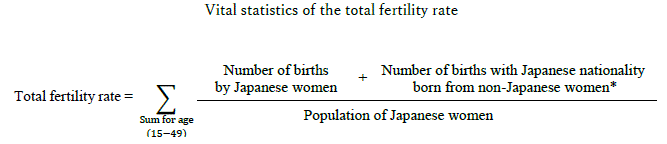
* A child with Japanese nationality born from a non-Japanese female is a child whose father is Japanese.
The results of the calculations above show that the total fertility rate of the same definition as the Vital Statistics, whose statistic value was 1.45 in 2015, is expected to gradually drop until it reaches 1.42 by 2024, whereupon it will increase slightly to 1.43 by 2035 and 1.44 by 2065 (see Table 4-1 and Figure 4-1).
With regard to the comparison of the total fertility with the previous projection at the end of the projection periods, the rate increased from 1.35 (2060) to 1.44 (2065) due to the improvement in the actual fertility rates for women in their 30s and 40s in recent years.
(2) High-fertility Assumption
(i) The mean age at first marriage of women by cohort will advance to 28.2 years of age for the cohort born in 2000, reach 28.1 years for the cohort born in 2015, and remain unchanged thereafter.
(ii) The proportion of women who have never been married at 50 years of age increases to 13.2% for the cohort born in 2000, ultimately dropping to 13.1% for the cohort born in 2015, and remains unchanged thereafter.
(iii) Using couples with wives in the cohorts born between 1935 and 1954 as a benchmark (1.0), the fertility variation coefficient of married couples, which indicates changes in the reproductive behavior of couples, declines temporarily but returns to 1.0 before the cohort born in 2000. The completed number of births from married couples derived from this coefficient and changes in first marriage behavior explained above will reach 1.91 children for the cohort born in 2000, maintain almost the same level up to the cohort born in 2015, and it will remain unchanged thereafter.
(iv) The coefficient of divorce, bereavement, and remarriage will decrease from the actual figure of 0.959 for the cohort born in 1964 to 0.955 for the cohort born in 2000, and maintain almost the same levels up to the cohort born in 2015, remaining unchanged thereafter.
From the assumptions (i) to (iv) above, the total cohort fertility rate of Japanese women is projected to decrease from the actual figure of 1.630 for the cohort born in 1964 to 1.591 for the cohort born in 2000, eventually reaching 1.594 for the cohort born in 2015 and remains unchanged thereafter.
Total fertility rate with the same definition as the Vital Statistics will, under the above assumptions, increase from the actual figure of 1.45 as of 2015 to 1.66 by 2024, eventually dropping to 1.65 by 2065 (see Table 4-1 and Figure 4-1).
(3) Low fertility Assumption
(i) The mean age at first marriage of women by cohort will increase to 29.0 years of age for the cohort born in 2000, and to 29.1 years of age for the cohort born in 2015 and remains unchanged thereafter.
(ii) The proportion of women who have never been married at 50 years of age increases to 24.7% for the cohort born in 2000, and maintains almost the same level up to the cohort born in 2015, remaining unchanged thereafter.
(iii) Uing couples with wives in the cohorts born between 1935 and 1954 as a benchmark (1.0), the fertility variation coefficient of married couples, which indicates changes in the reproductive behavior of couples, declines steadily to 0.909 for the cohort born in 2000, eventually reaching 0.910 for the cohort born in 2015 and remains unchanged thereafter. The completed number of births from married couples derived from this coefficient and the changes in first marriage behavior described above will decrease to 1.68 children for the cohort born in 2000, and remain unchanged until the cohort born in 2015 and thereafter.
(iv) The coefficient of divorce, bereavement, and remarriage will decrease from the actual figure of 0.959 for the cohort born in 1964, to 0.955 for the cohort born in 2000, and maintain almost the same levels up to the cohort born in 2015, remaining unchanged thereafter.
Based on assumptions (i) to (iv) above, the total cohort fertility rate of Japanese women will decrease from the actual figure of 1.630 for the cohort born in 1964, to 1.213 for the cohort born in 2000, eventually reaching 1.210 for the cohort born in 2015 and remains unchanged thereafter.
The total fertility rate with the same definition as the Vital Statistics will, under the above assumptions, decrease from the actual figure of 1.45 as of 2015 to 1.20 by 2024; thereafter, it will exhibit a slight increase to 1.25 by 2065 (see Table 4-1 and Figure 4-1).
Regarding the sex ratio at birth (the number of male children for every 100 female children) that is used to divide the future number of newborns into male and female births, we assumed the actual figure for the five years from 2011 to 2015 (105.2) to remain constant for 2016 and thereafter.
In order to project the population from one year to the next, survival rates by age and sex are needed, and in order to obtain future survival rates, it is necessary to construct future life tables. In the Projections, we have adopted the Lee-Carter model, which is currently internationally recognized as the standard model, to construct future life tables. We modified the model by adding new features so that the model adapts properly to Japan's characteristic mortality trend, which exhibits the highest level of life expectancy in the world. The Lee-Carter model describes the change in mortality rates for each age according to the change in the general mortality level by decomposing the matrix of age-specific mortality rates into a standard age schedule, a general level of mortality (mortality index), age-specific mortality rate changes relative to the mortality index, and an error term. In the Projections, we used the Lee-Carter model for the younger generations and combined it with a model that expresses the mortality rate improvement as a shift of the mortality rate curve to the advanced age side (linear differential model) for the older generations, in order to adapt to the mortality conditions of Japan, where mortality' rate improvement is notable. Note that the linear differential model describes the difference in the shift of the elderly mortality rate curve in the horizontal direction by a linear function of age.
When projecting the future mortality index, we used data from after 1970 in order to reflect changes in the level of mortality that gradually slowed down in recent years. From the perspective of ensuring consistency in terms of the mortality rate of men and women, curve fittings were applied simultaneously for both men and women. For the amount of shift and the gradient of the mortality rate curve to the advanced age side used in the linear differential model, we used the rate of change of the mortality index to make projections.
Because the improvement in Japanese mortality levels in recent years is showing trends beyond the assumptions of existing theories, we judged that the future mortality rate transitions and achieved levels will be highly uncertain as in the previous projections. Therefore, in the projections we decided to create multiple assumptions to obtain a likely fluctuation range for the projections. That is, we obtained the distribution of mortality index parameters for the standard mortality rate trend via the bootstrap method, and similarly used the distribution to estimate the 99% prediction interval of the mortality indices. Additionally, we added a "high-mortality" assumption with a high mortality rate, in which the mortality index remains at the upper limit level of the confidence interval, and a "low-mortality" assumption with a low mortality rate, in which the mortality index remains at the lower limit of the confidence interval.
Based upon the parameters and variables obtained through the procedures above, we finally calculated age- and sex-specific mortality rates until 2065 to construct the future life tables.
(1) Medium-mortality Assumption
According to the standard future life tables, life expectancy, which was 80.75 years for men and 86.98 years for women in 2015, is expected to grow to 83.27 years for men and 89.63 years for women by 2040, and 84.95 years for men and 91.35 years for women by 2065 (see Table 4-2 and Figure 4-2).
(2) High-mortality Assumption
According to the high-mortality assumption, the mortality rate will be higher and life expectancy will be shorter than compared to the medium variant. As a result, life expectancy according to this assumption will be 82.38 years for men and 88.71 years for women by 2040, and 83.83 years for men and 90.21 years for women by 2065.
(3) Low-mortality Assumption
According to the low-mortality assumption, the mortality rate will be lower and life expectancy will be longer than compared to the medium variant. As a result, life expectancy according to this assumption will be 84.15 years for men and 90.54 years for women by 2040, and 86.05 years for men and 92.48 years for women by 2065.
The trend of international migration is significantly influenced by the advancement of globalization and changes in socio-economic conditions, as well as the policies and regulations concerning international migration. In addition, socio-economic events and the occurrence of disasters inside and outside Japan can also bring about great fluctuations in international migration. Recent examples of such incidents include the terrorist attacks in the United States in 2001, the outbreak of SARS (Severe Acute Respiratory Syndrome) between 2002 and 2003, and the Lehman Crisis in 2008. Most recently, the Great East Japan Earthquake in March of 2011 had a significant impact on the immigration and emigration of non-Japanese people into and out of Japan.
The actual figures show that the trends of international migration rates and numbers differ between Japanese and non-Japanese populations. Additionally, considering the demographics, the movement of the Japanese population is influenced by the age structure of the population; however, for the non-Japanese population, the relation of their movement to the population size or age structure of Japan is limited. Therefore, in the projections, we made separate assumptions on international migration for the Japanese and non-Japanese populations. We set the figures of the Japanese population based on the net international migration rate, and those of the non-Japanese population based on the number of net migrants.
Looking at the actual statistics of international migration, the Japanese population shows a tendency of exits exceeding entries. In addition, the age patterns of the net international migration rate (net migration rate) by sex are relatively stable. We thus obtained the average value of the age- and sex-specific annual net international migration rate of Japanese people between 2010 and 2015 (using values for 4 years, excluding the maximum and minimum values for each age), smoothed out the rates to remove random fluctuations, and set the result as the net international migration rate of Japanese people for 2016 and onward (Table 4-3 and Figure 4-3).
Looking at the actual statistics of international migration of the non-Japanese population, the number of net migrants has generally shown a continuous increase, although some irregular fluctuations have been observed. However, quite recently, a large-scale excess of exits was observed due to the Lehman Crisis and the Great East Japan Earthquake. The trends of immigration and emigration of non-Japanese people showed great fluctuations in a short period of time. For this reason, we deliberately excluded data from years considered to show significant temporary transitions due to socio-economic events, disasters, etc. from our estimation of the number of net migrants of non-Japanese origin since 1970, projected a long-term trend of the number of net migrants, and set the result as the assumption until 2035. Note that the sex-specific number of net migrants of each year was calculated using the average values of the sex ratio of the number of net migrants from 1970 onward, and the age-specific proportion was obtained by smoothing the average values from 1986 to 2015, for which actual statistics are available (Table 4-4 to 4-5, Figure 4-4 to 4-5). However, in the long run, the scale of international migration of non-Japanese people must be interlocked with the population scale of Japan. We therefore obtained the age- and sex-specific net international migration rate in 2035 in each projection (using the total population of Japanese and non-Japanese people as the denominator) and assumed it to be constant thereafter.
* In this paper, we call the nine projections made by the above method until 2065 as "the basic projections."
(1) Long-range Auxiliary Projections
Although the end of the projection period for the basic projections is 2065, we made long-range auxiliary projections for the period from 2066 to 2115, which may be used as a reference for analysis of long-term population projections. In these projections, the survival rate-fertility rate, sex ratio at birth, and international migration rate are assumed to remain constant from 2066 (Table 5-1 to 5-6).
(2) Conditional Projections
Conditional projections are quantitative simulations for analyzing the responses of future populations to the changes of the assumptions in mechanical manners, which are made by means of basic projections every time to understand the results more clearly. In this paper, the results of the counterfactual simulations of the future population corresponding to various scenarios with different fertility and non-Japanese net migration levels are exhibited.
For the fertility rate, we use the three assumptions in the basic projections and create age-specific fertility rates by linear interpolation (extrapolation) of age-specific fertility rates for the three assumptions. As for the levels, we set the total fertility rates with the same definition as the Vital Statistics in 2065 as 1.00, 1.20, 1.40, 1.60, 1.80, 2.00, and 2.20.
For the non-Japanese net migration, we use the assumptions in the basic projections and create the number of net migrations for each year until 2035 by multiplying a single coefficient to those in the basic projections. As for the levels, we set the number of net migration in 2035 as 0, 50 thousand, 100 thousand, 250 thousand, 500 thousand, 750 thousand, and 1 million. As in the basic projections, we obtained the age- and sex-specific net international migration rate in 2035 in each projection (using the total population of Japanese and non-Japanese people as the denominator) and assumed it to be constant thereafter.
As for the results of the conditional projections, trends in total population and the proportion of the old-age population out of the entire population are exhibited in comparative tables.
* In the basic projections, neutrality and objectivity of the results are ensured by setting assumptions for fertility, mortality, and international migration using demographic projection methods based on the latest actual data as shown in the "Summary of the Method Used for Population Projections." Population projections could only become a common basis for planning in various areas through this procedure. (In light of the methodology in the setting of assumptions, the basic projections appear to show population trends in the change of the current society that would continue in the future).
Source: https://www.ipss.go.jp/pp-zenkoku/e/zenkoku_e2017/pp_zenkoku2017e_gaiyou.html
0 Response to "Japan s Population Continues to Grow at a Steady Rate"
Post a Comment